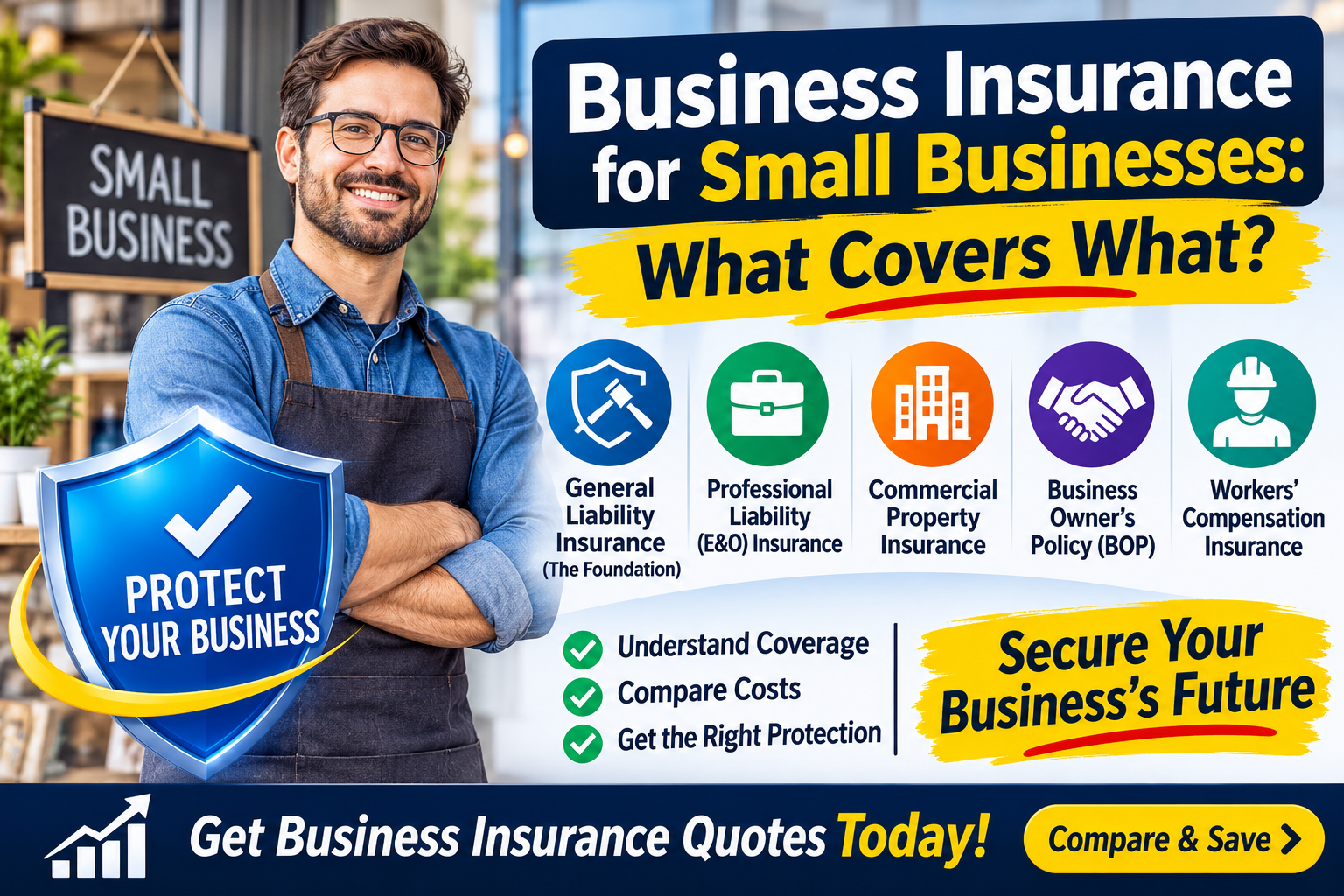
Starting a small business takes time, money, and dedication. But business insurance for small businesses can cover risks like customer injuries, property damage, employee accidents, lawsuits, and cyberattacks.
That’s why protecting your enterprise with appropriate coverage is an important part of managing business risks in the United States.
The right insurance coverage can help protect your equipment, inventory, employees, business property, and finances when covered incidents occur. However, not every business needs the same policy. A freelance consultant, retail store, construction company, and online business all face different risks.
In this guide, we’ll explain the main types of small business insurance, what each policy covers, how much coverage may cost, and how to compare business insurance quotes in 2026.
What Is Small Business Insurance?
Small business insurance refers to different insurance policies designed to protect companies against financial losses resulting from covered accidents, lawsuits, property damage, and other business-related risks.
Depending on your business operations, you may need one or several types of coverage.
For example:
- A retail store may need general liability and commercial property insurance.
- A consulting company may need professional liability insurance.
- A construction business may need general liability, workers’ compensation, and commercial auto coverage.
- An online business may benefit from cyber liability insurance.
The goal is to select coverage that matches your business activities, legal requirements, and financial risks.
1. General Liability Insurance
General liability insurance is one of the most common types of business insurance for small businesses. It protects companies against certain third-party claims involving bodily injuries, property damage, and personal or advertising injury.
What Does General Liability Insurance Cover?
Bodily Injury: If a customer slips on a wet floor inside your store and suffers an injury, general liability insurance may help cover eligible medical expenses and legal costs.
Property Damage: If your employee accidentally damages a customer’s property while performing a service, the policy may help pay for covered repair or replacement costs.
Personal and Advertising Injury: This can include certain claims involving libel, slander, or advertising-related offenses, subject to policy exclusions and conditions.
Who Needs General Liability Insurance?
This coverage can be useful for:
- Retail stores
- Restaurants
- Contractors
- Cleaning businesses
- Landscaping companies
- Small service providers
- Independent business owners
Many commercial landlords and clients also require businesses to provide proof of general liability coverage before signing contracts or leases.
2. Professional Liability Insurance (Errors and Omissions)
General liability insurance primarily addresses certain third-party bodily injury, property damage, and personal or advertising injury claims. It generally does not replace professional liability coverage.
Professional liability insurance, also called Errors and Omissions (E&O) insurance, protects businesses against certain claims alleging that professional services, advice, or work caused a client financial harm.
What Does E&O Insurance Cover?
Professional Negligence: A consultant provides incorrect business advice that allegedly causes a client financial loss.
Errors and Omissions: An accountant makes a professional error that results in a financial dispute with a client.
Failure to Meet Professional Standards: A client claims that a professional service did not meet the required standard of care.
Coverage depends on the policy, exclusions, and whether the claim meets the policy’s requirements. Contract disputes and missed deadlines are not automatically covered.
Who Needs Professional Liability Insurance?
This policy is particularly relevant for:
- Accountants
- Consultants
- IT professionals
- Marketing agencies
- Real estate professionals
- Financial service providers
- Freelancers and independent contractors
If your business provides advice, expertise, or professional services, consider whether E&O insurance is appropriate.
3. Commercial Property Insurance
Commercial property insurance helps protect the physical assets your business owns or uses.
Whether you operate a retail store, office, warehouse, or workshop, damage to business property can create significant financial problems.
What Does Commercial Property Insurance Cover?
Depending on the policy, coverage may include:
- Business buildings and office spaces
- Computers and electronic equipment
- Office furniture and fixtures
- Business inventory and supplies
- Machinery and tools
- Certain losses caused by fire, theft, vandalism, or covered weather events
Standard commercial property policies generally exclude flood and earthquake damage unless additional coverage is purchased.
Why Is Commercial Property Insurance Important?
Imagine a fire damages your office and destroys several computers, furniture items, and important equipment.
Without suitable insurance, your company may have to pay for repairs and replacements out of pocket.
Commercial property insurance can help reduce these financial losses when the damage is covered by your policy.
4. Business Owner’s Policy (BOP)
A Business Owner’s Policy, commonly known as a BOP, combines multiple types of business coverage into one insurance package.
For many eligible small businesses, this can be a convenient and cost-effective option.
What Does a BOP Include?
A typical Business Owner’s Policy combines:
- General liability insurance
- Commercial property insurance
- Business interruption coverage
What Is Business Interruption Insurance?
Business interruption insurance may help replace lost business income and cover certain ongoing operating expenses when a covered property loss forces your company to temporarily suspend operations.
For example, if a covered fire makes your restaurant temporarily unusable, business interruption coverage may help with eligible lost income and continuing expenses during the recovery period.
Coverage depends on the policy’s covered causes of loss, waiting periods, limits, and other conditions.
Important: A BOP does not automatically include every type of business insurance. Workers’ compensation, commercial auto, and professional liability generally require separate policies.
The National Association of Insurance Commissioners (NAIC) provides additional information about Business Owner’s Policies and small business insurance.
5. Workers’ Compensation Insurance
Workers’ compensation insurance provides benefits to eligible employees who experience work-related injuries or occupational illnesses.
For many U.S. businesses with employees, workers’ compensation is a legal requirement. However, the rules differ by state, industry, business structure, and number of employees.
What Does Workers’ Compensation Cover?
Medical Expenses: Eligible medical treatment, hospital visits, medications, and rehabilitation.
Lost Wages: Partial wage replacement when an employee cannot work because of a qualifying workplace injury.
Disability Benefits: Benefits may be available for qualifying temporary or permanent disabilities.
Death Benefits: Eligible dependents may receive benefits when a work-related injury or illness results in an employee’s death.
Is Workers’ Compensation Required in Every State?
Requirements vary across the United States. Some states have different employee-count thresholds and exemptions, while certain industries have special requirements.
Business owners should check their state’s workers’ compensation regulations before hiring employees.
You can find state workers’ compensation offices through the U.S. Department of Labor’s state directory.
6. Cyber Liability Insurance
As more companies depend on websites, online payments, cloud storage, and customer databases, cyber risks have become an important business concern.
Cyber liability insurance may help businesses manage certain financial losses associated with cyber incidents, depending on the policy.
What Does Cyber Insurance Cover?
Potential coverage includes:
- Data breach response expenses
- Certain data recovery costs
- Cyberattack investigation expenses
- Customer notification expenses
- Certain legal and regulatory defense costs
- Business interruption resulting from covered cyber incidents
Who Should Consider Cyber Liability Insurance?
Cyber insurance may be particularly useful for:
- E-commerce businesses
- Online retailers
- Digital marketing agencies
- Healthcare-related businesses
- Financial service providers
- Companies storing customer information
Small businesses should review their cybersecurity risks and consider whether a separate cyber policy is appropriate.
7. Commercial Auto Insurance
If your company owns vehicles or employees use vehicles for business activities, commercial auto insurance may be necessary.
Personal auto insurance generally does not provide the same protection for all business-related driving activities.
What Can Commercial Auto Insurance Cover?
Depending on the selected coverage, policies may include:
- Liability for covered vehicle accidents
- Collision damage
- Comprehensive coverage
- Certain uninsured or underinsured motorist losses
- Coverage for eligible business-owned vehicles
Businesses that use cars, vans, pickup trucks, or delivery vehicles should discuss their commercial driving activities with a licensed insurance professional.
How Much Does Small Business Insurance Cost in 2026?
The cost of small business insurance depends on several factors, including your industry, location, annual revenue, payroll, number of employees, claims history, and selected coverage limits.
There is no single price that applies to every business.
For a useful reference, 2026 pricing research from MoneyGeek reports an average general liability premium of approximately $1,474 annually for its modeled small-business profiles. Its modeled Business Owner’s Policy average is approximately $2,675 annually.
These are research benchmarks, not guaranteed quotes. Actual prices can vary considerably between businesses and insurers.
Factors That Affect Business Insurance Premiums
1. Business Industry
Construction, manufacturing, and other higher-risk operations may have higher premiums than lower-risk professional services.
2. Business Location
Insurance costs can vary by state, city, local weather exposure, property risks, and insurance regulations.
3. Annual Revenue and Payroll
Insurers may use revenue, payroll, and employee numbers when evaluating certain business risks and calculating premiums.
4. Claims History
Previous claims may influence underwriting decisions and future premiums.
5. Coverage Limits and Deductibles
Higher coverage limits can increase premiums. Choosing a higher deductible may reduce the premium but increases your potential out-of-pocket costs after a covered claim.
How to Choose the Best Small Business Insurance
Choosing the right business insurance policy requires more than comparing prices.
Follow these practical steps before purchasing coverage.
Step 1: Identify Your Business Risks
Make a list of your business activities, physical assets, employees, vehicles, customer interactions, and professional responsibilities.
Step 2: Understand Your Legal Requirements
Check your state’s insurance requirements, particularly if you employ workers or operate commercial vehicles.
Step 3: Compare Multiple Insurance Quotes
Request quotes from multiple insurance companies or an independent insurance agent.
Compare policies using similar coverage limits and deductibles to make the results meaningful.
Step 4: Review Coverage Exclusions
Read the policy documents carefully. Pay attention to excluded risks, waiting periods, claim reporting deadlines, and coverage limitations.
Step 5: Consider Bundling Policies
Ask insurers whether a Business Owner’s Policy can combine the coverage your business needs at a competitive price.
Step 6: Review Your Coverage Annually
Your insurance requirements may change as your company hires employees, increases revenue, purchases equipment, or expands operations.
Review your coverage whenever your business experiences a significant change.
Frequently Asked Questions About Small Business Insurance
What insurance does a small business need?
Many small businesses consider general liability and commercial property insurance. Professional service providers may also need E&O coverage, while businesses with employees may need workers’ compensation depending on state law.
How much does small business insurance cost per month?
The monthly cost varies by business type and coverage. For example, MoneyGeek’s 2026 modeled average for general liability is approximately $123 per month. This is a benchmark rather than a guaranteed premium.
Is small business insurance legally required?
Some policies are required depending on state laws, employee numbers, business activities, and other circumstances. Workers’ compensation is a common example. Landlords and clients may also contractually require certain coverage.
What is the difference between general liability and professional liability?
General liability generally covers certain third-party bodily injury, property damage, and personal or advertising injury claims. Professional liability addresses certain claims that professional services or advice caused financial harm.
Does a BOP include workers’ compensation?
Typically, no. A standard Business Owner’s Policy generally combines general liability and commercial property coverage, often with business interruption protection. Workers’ compensation usually requires separate coverage.
Can a home-based business get insurance?
Yes. Home-based businesses may be eligible for business insurance, including a BOP or separate business property and liability policies. Standard homeowners insurance may not adequately cover business-related risks.
Does business insurance cover cyberattacks?
Not necessarily. Cyber liability insurance is generally a separate policy or optional coverage. Businesses should review their existing policies to understand whether any cyber-related protection is included.
Final Thoughts
Business insurance for small businesses is an important part of protecting your company’s financial future. From customer injury claims and property damage to professional mistakes and cyber incidents, the right coverage can help reduce the financial impact of unexpected events.
The best insurance solution depends on your business activities, location, employees, assets, and potential risks.
Before purchasing a policy, compare multiple business insurance quotes, review exclusions, and understand the coverage limits.
Taking the time to choose appropriate protection today can help your business prepare for tomorrow.
Disclaimer: This article is for general educational purposes only and does not constitute legal, financial, or insurance advice. Insurance requirements, premiums, coverage limits, and exclusions vary by state, insurer, and policy. Consult a licensed insurance professional for advice about your specific business.
Sources and Further Reading